
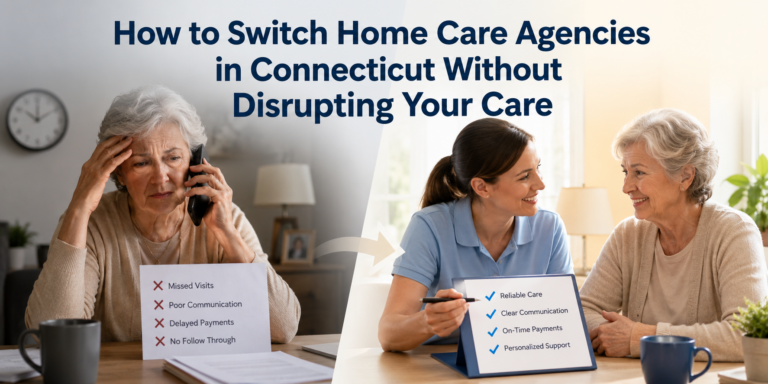
How to Switch Home Care Agencies in Connecticut Without Disrupting Your Care
If something is not working with your current home care agency, you do not have to continue care with the same provider. Connecticut seniors enrolled in CHCPE programs have the right to switch providers, and doing so does not mean losing services, starting over with DSS, or putting your care arrangement at risk. What it does mean is finding a team that actually shows up the way they should.
This is what the process looks like, and what you can expect at each stage.
Can you switch home health agencies in Connecticut?
Yes, and it is more straightforward than most people expect. Seniors enrolled in AFL or PCA under the Connecticut Home Care Program for Elders are not locked into a provider. The right to change agencies is built into the program.
Your CHCPE enrollment stays in place throughout the transition. When you are ready to switch, your care manager coordinates the process. Your current provider continues care until the new agency is confirmed and ready to begin. There is no period where you are left without support.
Reasons Connecticut Seniors Change Home Care Agencies
The decision to switch looks different depending on which program a senior is enrolled in, because AFL and PCA involve very different care arrangements and very different relationships with the provider agency. Before getting into the specifics, it is worth saying that there is no threshold of dissatisfaction you need to meet before switching is justified. If the arrangement is not working, that is reason enough.
That said, some frustrations come up across both programs: feeling like the agency was fully present during the enrollment process and then difficult to reach afterward, not receiving clear information about what the senior is entitled to, or simply feeling like your situation is not being handled with care.
Under the Adult Family Living Program
In AFL, the agency plays an ongoing role in the caregiver’s daily life. They manage the stipend, coordinate nursing visits, oversee the care plan, and are supposed to be a reliable resource when the caregiver has questions or the senior’s needs change. When that support is absent or inconsistent, the caregiver absorbs the weight of it while continuing to provide full time care.
Families in AFL commonly consider changing agencies when:
- Stipend payments are delayed without explanation
- The assigned nurse or care manager is hard to reach or does not follow through
- The annual reassessment is handled carelessly, which directly affects the care level and the caregiver’s compensation
- Guidance is lacking when the senior’s care needs shift between assessments
- The agency seemed attentive at the start and then went quiet
Under the Personal Care Attendant Program
In the PCA Program, the agency is responsible for recruiting, training, and coordinating the personal care attendant who visits the senior. Unlike in the AFL program, PCAs cannot be immediate family members. They are trained professionals placed by the agency, which means when the agency’s coordination falls short, it affects the quality and consistency of every visit.
Seniors in the PCA program commonly consider switching when:
- Attendant visits are missed, rescheduled frequently, or poorly timed
- There is a high turnover of attendants that makes it impossible to build any consistency
- Requests to match the senior with a different attendant go unaddressed
- Nursing oversight feels like a formality rather than genuine care management
- Communication from the agency is slow or vague when issues are raised
What Happens to Your CHCPE Benefits When You Change Agencies?
This is the question that holds most Connecticut seniors back from making a change they know they need. The answer is straightforward. Your CHCPE benefits do not stop when you change home care agencies in Connecticut. Eligibility under the Connecticut Home Care Program for Elders is tied to you, not to any provider.
What matters during the transition:
- Your CHCPE enrollment and eligibility remain active throughout the process
- Your care manager coordinates the switch and informs DSS on your behalf
- In most cases a new assessment is not required, and your existing care level and documentation carry forward to the new provider
- Your current agency is required to continue services until the transition is confirmed and the new provider is ready to begin
Nothing about switching resets your standing with CHCPE. The goal of the transition process is continuity, and a good agency manages it with exactly that in mind.
What Happens to Your Care Arrangement When You Switch Providers
How the transition affects daily care depends on which program the senior is enrolled in. AFL and PCA work differently, so the changeover experience is different for each.
Under the Adult Family Living Program
In AFL, the caregiver and the senior share a home. That arrangement does not change when the agency changes. The caregiver continues in their role and moves with the senior to the new provider. What changes is who manages the program behind the scenes: the nursing visits, the care plan reviews, the stipend processing, and the ongoing support for the caregiver.
Once the decision to switch is made, the care manager is informed and coordinates the transition. In most cases, a new assessment is not required. The care manager works with both the outgoing and incoming providers to ensure the process moves smoothly and that services continue without interruption throughout.
For AFL families, the most important constant in the arrangement, the caregiver providing daily support in the home, stays exactly the same.
Under the Personal Care Attendant Program
In the PCA Program, the attendant is coordinated through the agency, which means switching providers may also mean a different attendant coming in. That is worth knowing ahead of time so the senior and their family can prepare for that change.
Once the decision to switch is made, the care manager is informed and coordinates the transition to the new provider. In most cases, a new assessment is not required. The new agency works with the care manager to establish the care arrangement and assign a trained attendant based on the senior’s existing care plan. Families can share preferences about who comes in, and a good agency takes those preferences seriously during that process.
Switching Home Care Agencies in Connecticut Without Handling the Paperwork Yourself
One of the main reasons Connecticut seniors hesitate to switch is the assumption that it involves navigating a complicated paperwork process on their own. It does not. Once you inform your care manager of your decision to switch, they take on the coordination. If you already have a new agency in mind, you simply provide their name. If you do not, your care manager can share a list of local providers and in some cases recommend one based on your needs.
What you and your family typically need to provide is straightforward: the name of the new agency if you have one, and basic identifying information. The care manager and the new agency handle the rest.
If a provider ever suggests you manage the transition process yourself, that is a sign worth paying attention to.
How to Transfer Care from One Provider to Another in Connecticut: A Step by Step Guide
- Step 1: Find a new DSS-authorized agency Confirm the agency is authorized to provide AFL or PCA services under CHCPE in Connecticut and is currently accepting new seniors.
- Step 2: Start the conversation Reach out to the new agency. A good provider will take time to understand the situation, explain the process clearly, and answer questions before anything moves forward.
- Step 3: Contact your care manager Let your care manager know you would like to switch and provide the name of the new agency. A new assessment is in most cases not needed. If you do not have a specific agency in mind yet, your care manager can share a list of local providers and in some cases may recommend one based on the senior’s needs.
- Step 4: The transition is coordinated Once the care manager is informed and the new agency is confirmed, the new provider coordinates directly with DSS to formalize the switch. The current agency continues services until everything is in place and the new provider is ready to begin.
- Step 5: Transition and start of care Once the transition is confirmed, a start date is agreed upon and the new agency takes over all care coordination, nursing oversight, and program management from that point forward.
How Long Does It Take to Switch Home Care Agencies in Connecticut
Most families can expect the transition to take between two and four weeks from the first conversation with the new agency to the first day of care under the new provider. Because the care manager coordinates the transition and a new assessment is not typically required, the process in Connecticut can move relatively quickly once the decision is made. The timeline depends on care manager availability, how quickly the new agency can be confirmed, and whether any additional documentation is needed.
An agency that is experienced with CHCPE transitions and communicates proactively throughout will make a meaningful difference in how smoothly the process goes.
What to Look for in a New Home Care Agency in Connecticut
Choosing a new provider is a decision worth taking seriously. A few things that apply regardless of whether the senior is in AFL or PCA program:
- DSS authorization — the agency must be authorized to provide AFL or PCA services under CHCPE in Connecticut
- Experience with CHCPE transitions — ask whether they have managed provider changes before and what their process looks like
- Responsiveness before enrollment — how they communicate when you are still a prospective client tells you a great deal about how they will communicate once care begins
- Quality of nursing oversight — regular visits and genuine care plan reviews are a core program requirement, not an optional extra
- Transparency — the right agency walks you through every step without rushing you or leaving gaps in the explanation
- Ongoing support — enrollment should be the beginning of the relationship, not the end of it
How Gifted Hands Homecare Supports Your Transition in Connecticut
At Gifted Hands Homecare, we know that by the time most families contact us about switching, they have been managing more than they should have had to on their own. We are a DSS authorized provider in Connecticut offering both AFL and PCA programs under CHCPE, and we handle the full transition process at no cost to the senior or their family.
From the first conversation, coordination and the first day of care with us, we are with you the whole way. If you are ready to see what a different experience feels like, reach out and we will take it from there.