
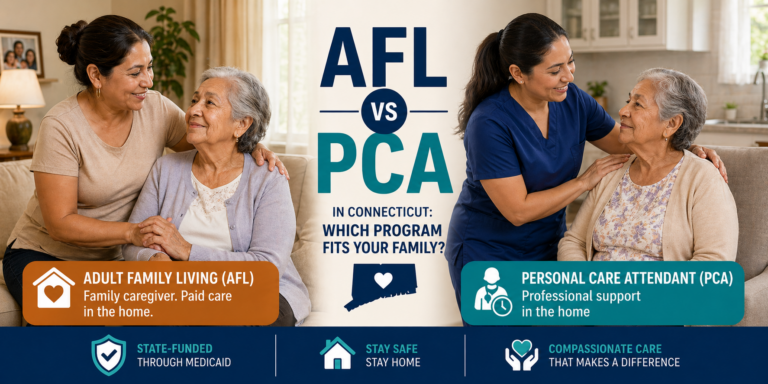
Adult Family Living vs Personal Care Attendant in Connecticut: Which Program Fits Your Family?
Connecticut families caring for an aging loved one have two state-funded options to help pay for care at home: Adult Family Living and Personal Care Attendant. One lets a family member get paid to provide care. The other brings a trained professional into the home to provide care.
Both work and are funded by Connecticut Medicaid, but they are not the same. The right choice depends entirely on your family’s living situation and who is available to provide care.
How Connecticut Funds Home Care for Seniors
Both AFL and PCA operate under the Connecticut Home Care Program for Elders, or CHCPE. This is the state’s Medicaid-funded alternative to nursing home placement. For seniors aged 65 and older who meet the criteria, CHCPE covers the cost of care at home.
The senior eligibility requirements are the same whether you pursue AFL or PCA. A senior must be a Connecticut resident, need help with daily activities such as bathing, dressing or mobility, and meet the state’s financial guidelines. The programs only diverge when you look at who provides the care and where.
What Is the Adult Family Living (AFL)Program in Connecticut?
AFL allows a family member or close friend to become the senior’s paid caregiver. The caregiver must live in the same home as the senior. They receive a tax-free monthly stipend through Connecticut Medicaid based on the level of care the senior requires.
An agency on aging care manager conducts an in-home assessment and assigns one of four care levels. The higher the need, the higher the pay. Caregivers can receive up to $2,700 per month.
The program is designed for family members such as adult children, siblings, or close friends who are already providing care or willing to move in to do so.
What Is the Personal Care Attendant (PCA) Program in Connecticut?
PCA connects a senior with a trained personal care attendant who visits the home on a scheduled basis. The attendant does not live with the senior. They come during approved hours to help with specific tasks like bathing, dressing, grooming, and mobility.
An agency on aging care manager care manager determines how many hours per week the senior qualifies for based on their level of need. Hours typically range from 12 to 56 hours per week. The attendant is recruited and trained through a DSS-authorized provider. Seniors and their families do not need to find or hire the attendant on their own.
How AFL and PCA Differ for Families
The senior eligibility is the same for both programs. The difference is in who provides care and where.
Adult Family Living (AFL):
- The caregiver must live in the same home as the senior
- An adult child, sibling, or close friend can be the paid caregiver
- A spouse or legal guardian cannot be the caregiver
- The caregiver receives a tax-free monthly stipend
- Care happens continuously because they share the home. There are no shifts, no clocking out, and no gaps between visits.
Personal Care Attendant (PCA):
- The caregiver does not live with the senior
- An adult child, sibling, or close friend cannot be the paid caregiver
- A spouse or legal guardian cannot be the caregiver
- A trained attendant visits during scheduled hours approved by an agency on aging care manager
- The program is structured around scheduled visits rather than continuous presence.
What Daily Care Looks Like Under Each Program
Under AFL:
The caregiver is present from morning through evening because they live in the home. Personal care, meals, medication reminders, mobility support, and supervision all happen within the flow of a shared household. The caregiver does not clock out.
For seniors with memory issues, dementia, or high supervision needs, that continuous presence makes a significant difference. The trade-off is limited flexibility. If the caregiver needs time away, coverage must be planned in advance.
Under PCA:
A trained attendant arrives during scheduled hours, assists with approved tasks, and leaves. Outside of those hours, the senior manages independently or with informal family support. The limit is the ceiling on hours. The program is designed around scheduled visits rather than continuous presence.
Both programs include professional nursing oversight through the provider agency, so families are not managing complex care situations without support.
Choosing Between AFL and PCA Based on Real Situations
AFL is likely the right fit if:
- A family member is already providing daily informal care and wants to be financially supported for it
- The senior needs consistent supervision throughout the day
- The living arrangement is already in place or feasible to set up
- Continuity of caregiver is the priority
PCA is likely the right fit if:
- No family member is available or able to move in and provide full-time care
- The senior needs structured daily support with tasks like bathing, dressing, or grooming
- The family prefers a professionally trained attendant
- The senior lives alone and a visiting care model fits their situation
Two Mistakes Families Make When Choosing a Program
Mistake 1: Selecting AFL based primarily on the stipend without fully understanding the live-in commitment. The compensation is real but so is the responsibility of sharing a home with the senior, with no scheduled shift end and no automatic daily backup. (Respite coverage for planned time away is available through the program, but it requires advance arrangement.)
Mistake 2: Assuming an adult child, sibling, or other family member can serve as the paid attendant under PCA. PCA requires a trained attendant who is not an immediate relative of the senior. Family members cannot fill this role.
Selecting the appropriate program at the outset avoids the need to switch later, which requires a new assessment.
How Gifted Hands Homecare Helps Connecticut Families
Knowing which program fits your family’s situation is one thing. Getting through the eligibility review, Medicaid enrollment, assessment, and application process is another.
Gifted Hands Homecare is a DSS-authorized provider in Connecticut that handles the entire process from start to finish at no cost to the family, including:
- Eligibility review for AFL and PCA
- Medicaid enrollment support for seniors not yet enrolled
- Program selection guidance based on your specific situation
- Full application coordination with DSS
Whether you are a family member already providing care or looking for professional support for a loved one, our team is available to answer questions and help you move forward when you are ready.